
Building Capability Infrastructure in Professional Firms
Effective professional development depends on more than training delivery. Sustainable capability growth requires a supporting infrastructure that connects learning, supervision, feedback, governance and workplace practice. Understanding these components allows firms to move from isolated development activities to a coherent capability system.
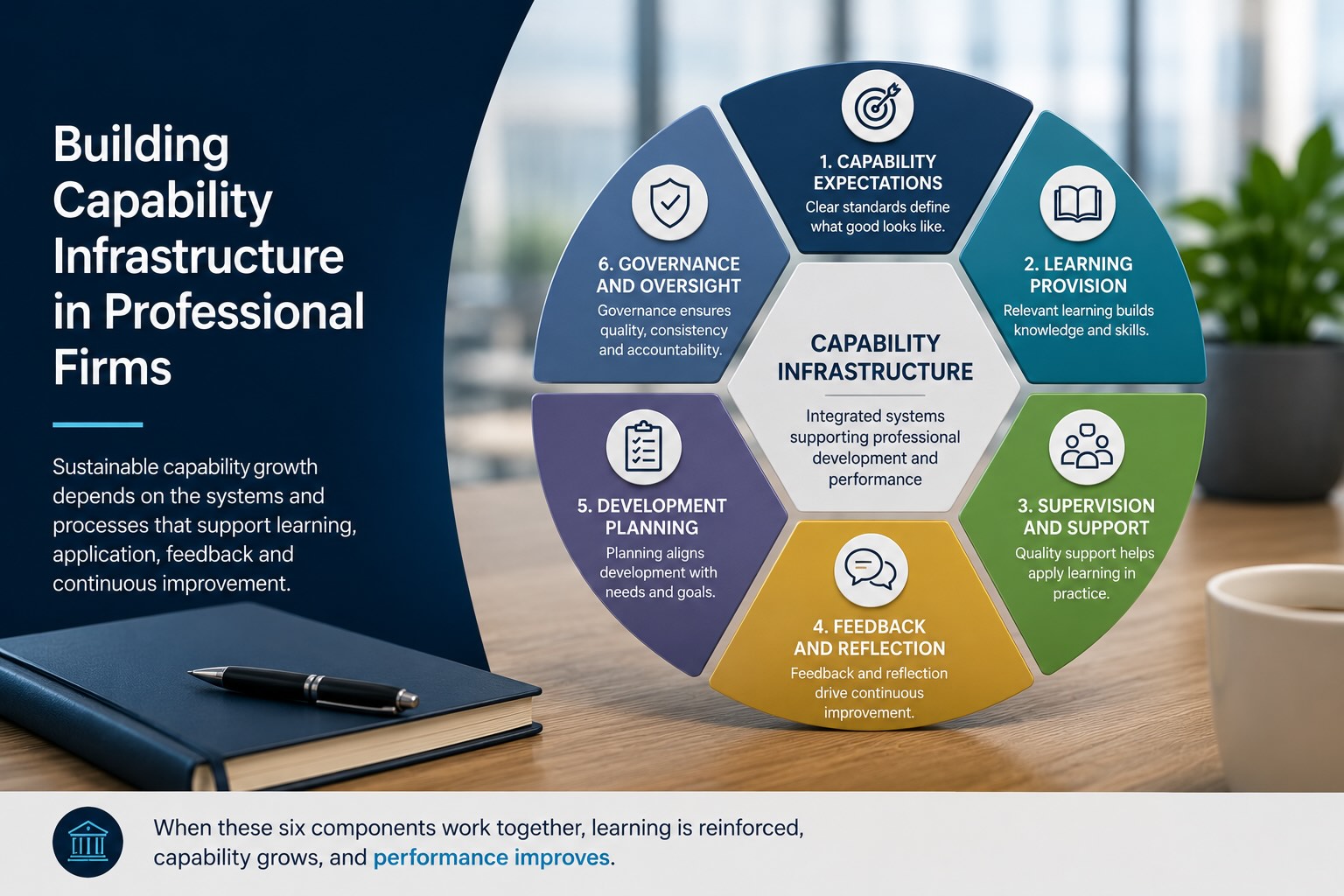
From Development Activity to Development System
Many professional firms have invested significantly in learning and development over recent years. Training programmes have expanded, online learning has become commonplace, and continuing competence requirements have increased the focus on professional development.
Yet despite these investments, many organisations continue to encounter familiar challenges:
- Development activity varies significantly between teams.
- Learning outcomes are difficult to measure.
- Supervisors approach development inconsistently.
- Professional skills develop unevenly across the organisation.
- Training records exist without clear evidence of capability growth.
These challenges often arise because development activities have evolved independently rather than as part of an integrated system.
Capability infrastructure provides the framework that connects these activities and supports consistent development outcomes.
What Is Capability Infrastructure?
Capability infrastructure is the collection of systems, processes, roles and mechanisms that support professional development across an organisation.
Rather than focusing solely on learning delivery, capability infrastructure considers everything required to help individuals develop, apply and sustain professional competence.
It creates the conditions that allow development to occur consistently, regardless of team, manager or practice area.
Most importantly, it recognises that capability development is an organisational process rather than an individual event.
The Six Core Components of Capability Infrastructure
While every organisation will design its systems differently, effective capability infrastructure generally consists of six interconnected components.
1. Capability Expectations
Development cannot occur without clarity regarding expected performance.
Individuals need a clear understanding of:
- Required competencies
- Professional standards
- Expected behaviours
- Technical capabilities
- Role-specific requirements
Capability frameworks, competence standards and professional expectations provide the foundation upon which development systems are built.
Without clear expectations, development activity can quickly become unfocused and difficult to evaluate.
2. Learning and Development Provision
Learning remains an essential component of capability infrastructure.
This includes:
- Formal training programmes
- Workshops and seminars
- Digital learning resources
- Professional qualifications
- Skills development activities
However, effective infrastructure treats learning as one component of capability development rather than the entire solution.
Training provides knowledge and skills. Infrastructure helps individuals apply them.
3. Supervision and Support
Professional development is heavily influenced by the quality of supervision individuals receive.
Managers, supervisors and senior colleagues play a critical role in:
- Reinforcing learning
- Providing practical guidance
- Supporting application in practice
- Identifying development needs
- Encouraging continuous improvement
Where supervision is inconsistent, development outcomes often become inconsistent as well.
Strong capability systems recognise supervision as a development mechanism rather than simply a management responsibility.
4. Feedback and Reflection
Capability improves when individuals understand how their performance compares with expectations.
Effective infrastructure creates regular opportunities for:
- Performance feedback
- Reflective practice
- Development conversations
- Skills reviews
- Progress discussions
Feedback provides visibility. Reflection supports learning. Together they create the continuous improvement cycle that underpins professional development.
5. Development Planning
Learning activity is most effective when linked to identified needs and future objectives.
Development planning helps organisations:
- Prioritise learning investment
- Address capability gaps
- Support career progression
- Align development with organisational requirements
- Monitor progress over time
Without structured planning, development often becomes reactive rather than purposeful.
6. Governance and Oversight
Governance provides consistency and accountability.
This component is frequently overlooked but often determines whether development systems remain effective over time.
Governance may include:
- Continuing competence arrangements
- Development policies
- Quality assurance processes
- Professional standards monitoring
- Capability reporting mechanisms
These structures ensure that development remains visible, supported and aligned with organisational objectives.
Why the Components Must Work Together
The greatest mistake organisations make is treating these elements as separate activities.
A capability framework without meaningful supervision has limited value.
Training without feedback may produce learning but not behavioural change.
Development plans without governance often become administrative exercises.
The effectiveness of capability infrastructure depends not only on the quality of individual components but also on how they interact.
The strongest systems create clear links between expectations, learning, supervision, feedback, planning and governance.
This integration creates consistency and reinforces development throughout the employee lifecycle.
Designed Systems Outperform Inherited Systems
Many professional firms have capability infrastructure already.
The challenge is that these systems have often evolved gradually over time.
Processes may exist because they have always existed. Different teams may operate differently. Development responsibilities may be unclear.
As organisations grow, inherited arrangements frequently become difficult to manage and difficult to scale.
Designed systems offer a different approach.
Rather than allowing capability arrangements to develop organically, organisations intentionally determine:
- What capability means.
- How development will be supported.
- Who holds responsibility.
- How progress will be measured.
- How standards will be maintained.
This intentional design improves consistency, transparency and effectiveness.
Infrastructure Creates Scalability
One of the most important benefits of capability infrastructure is scalability.
Without infrastructure, development often depends on individual managers, local practices and personal commitment.
This can work effectively within small teams but becomes increasingly difficult as organisations expand.
Capability infrastructure enables firms to:
- Maintain consistent standards.
- Support larger populations.
- Improve development visibility.
- Demonstrate competence more effectively.
- Create sustainable development arrangements.
In this sense, infrastructure provides the platform upon which long-term capability development can be built.
Key Takeaways
- Capability infrastructure consists of interconnected development systems and processes.
- Effective infrastructure extends far beyond training delivery.
- Six core components underpin most capability systems: expectations, learning, supervision, feedback, planning and governance.
- Weakness in one area can undermine development outcomes elsewhere.
- Designed systems generally outperform inherited arrangements.
- Capability infrastructure supports consistency, visibility and scalability.
Conclusion
Professional development is often viewed through the lens of learning activity. However, capability growth depends upon a wider system of support, oversight and reinforcement.
Capability infrastructure provides the framework that connects development activities and helps organisations achieve more consistent outcomes.
By understanding the major components of capability infrastructure and how they interact, firms can begin moving from isolated development initiatives towards a more coherent and sustainable capability system.
The question is no longer whether development activity exists. The more important question is whether the infrastructure supporting that activity is fit for purpose.
Further Consideration
If your organisation is seeking stronger development outcomes, consider assessing not only the quality of learning provision but also the strength of the systems that support supervision, feedback, planning and governance across the wider capability environment.
CONTINUE READING
Read Other Articles in This Series
Previous Article
Designing a Competence Governance System
Next Article
Capability Infrastructure Framework for Legal Practices
Explore Related Topics

Mapping Your Learning & Development To The SRA Statement of Solicitor
Recommended Next Step
-
Capability Infrastructure Framework for Legal Practices
