
Capability Infrastructure Framework for Legal Practices
Many firms recognise the importance of professional development but struggle to assess whether their underlying systems are capable of supporting sustainable capability growth. A capability infrastructure framework provides a practical method for evaluating development arrangements, identifying weaknesses and strengthening the structures that support professional competence over time.
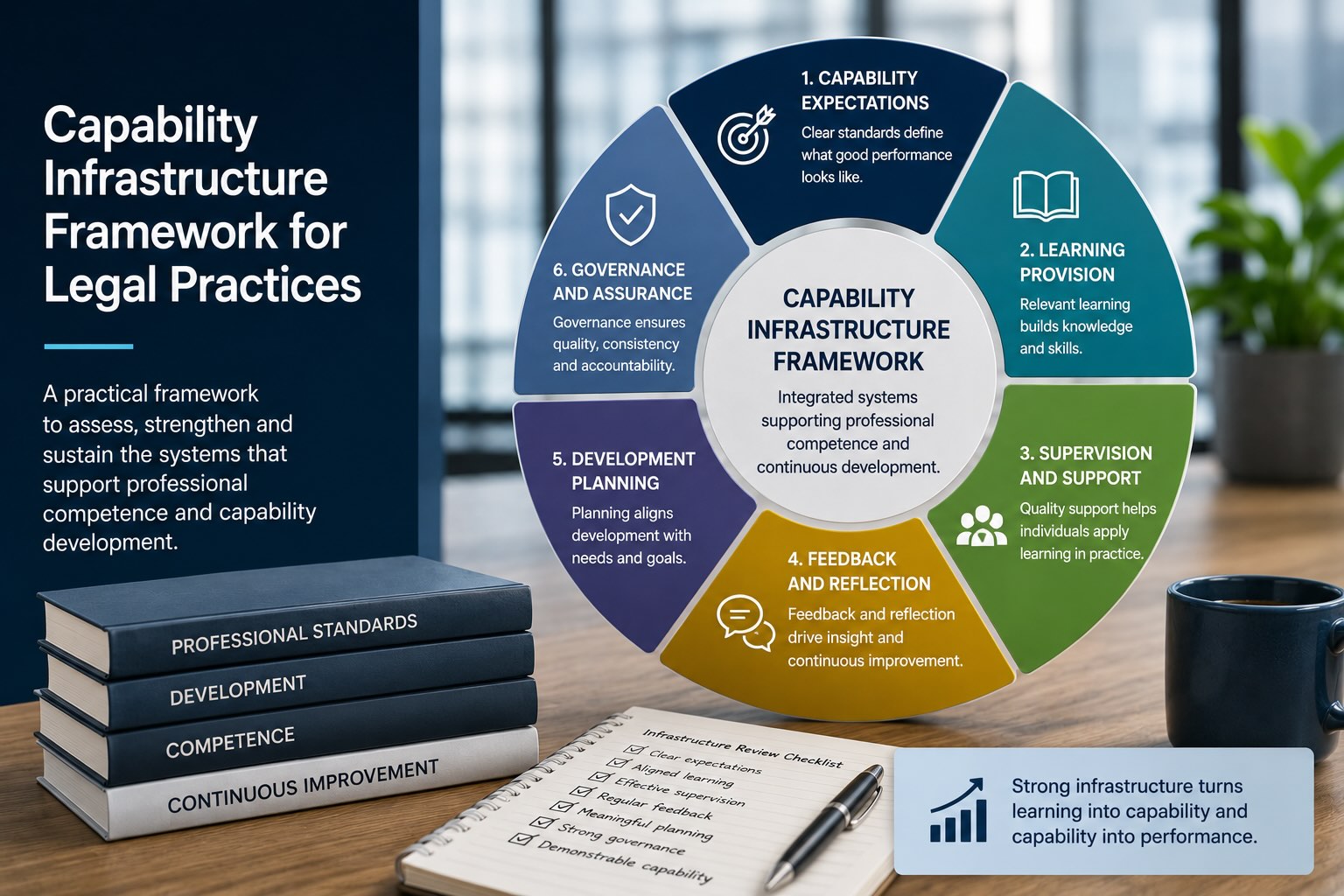
Why Capability Infrastructure Needs a Framework
In many legal practices, professional development evolves incrementally.
Training programmes are introduced to address immediate needs. Supervision arrangements develop within teams. Appraisal processes change over time. Competence requirements are added in response to regulatory expectations.
Individually, these initiatives may be valuable. Collectively, however, they do not always form a coherent system.
As a result, firms often encounter familiar challenges:
- Development activity is difficult to coordinate.
- Capability gaps remain hidden until problems emerge.
- Learning outcomes are inconsistent across teams.
- Supervisors adopt different approaches.
- Continuing competence evidence varies significantly in quality.
- Development investment is difficult to evaluate.
These issues are rarely caused by a lack of effort. More commonly, they reflect the absence of a framework for reviewing how development systems work together.
A capability infrastructure framework provides that structure.
What Is a Capability Infrastructure Framework?
A capability infrastructure framework is a structured method for assessing the systems that support professional development.
Rather than focusing solely on training delivery, the framework evaluates the wider environment that enables capability to develop and be maintained.
Its purpose is to answer a simple but important question:
“Do our development systems consistently support professional competence?”
The framework allows firms to identify strengths, expose weaknesses and prioritise improvement activity in a systematic way.
The Six Infrastructure Domains
Building on the capability infrastructure model introduced in CI002, legal practices can assess their development arrangements across six interconnected domains.
1. Capability Expectations
This domain considers whether the organisation has clearly defined what good performance looks like.
Key questions include:
- Are competence expectations clearly documented?
- Do individuals understand what is expected of them?
- Are professional standards linked to roles and responsibilities?
- Are behavioural and professional skills expectations visible?
Without clarity of expectation, development becomes difficult to direct or evaluate.
2. Learning Provision
This domain assesses how learning opportunities support capability development.
Questions may include:
- Is learning aligned to identified capability needs?
- Does provision cover both technical and professional skills?
- Are learning opportunities accessible and relevant?
- Is learning linked to workplace application?
The objective is not simply to provide learning but to ensure learning supports capability outcomes.
3. Supervision and Support
This domain examines the quality of workplace support available to learners.
Consider:
- Are supervisors equipped to support development?
- Are development responsibilities clearly understood?
- Is supervision consistent across teams?
- Do individuals receive meaningful support following learning activities?
Effective supervision is often one of the strongest predictors of successful capability development.
4. Feedback and Reflection
This domain reviews how organisations support continuous improvement.
Questions include:
- Is feedback regular and constructive?
- Are reflective practices encouraged?
- Do development conversations occur consistently?
- Is learning reinforced through performance review?
Feedback and reflection help transform experience into capability.
5. Development Planning
This domain focuses on how development priorities are identified and managed.
Assessment areas include:
- Are development plans meaningful and current?
- Are capability gaps identified systematically?
- Is progress monitored over time?
- Are development objectives linked to organisational needs?
Strong planning ensures development activity remains purposeful rather than reactive.
6. Governance and Assurance
This domain considers whether development systems are monitored effectively.
Questions may include:
- Is capability development subject to oversight?
- Are continuing competence arrangements robust?
- Is development data reviewed?
- Can the organisation demonstrate capability improvement?
Governance provides visibility and helps maintain consistency across the organisation.
Using a Maturity Assessment Approach
Not all firms will be at the same stage of development.
For this reason, capability infrastructure is often best assessed using a maturity model.
A simple four-stage approach can be highly effective.
Level 1: Ad Hoc
Development arrangements exist but are largely informal and inconsistent.
Characteristics include:
- Reliance on individual managers
- Limited documentation
- Inconsistent supervision
- Reactive development activity
Level 2: Developing
Basic systems have been introduced but are not yet fully integrated.
Characteristics include:
- Formal training provision
- Emerging competence processes
- Some development planning
- Limited oversight
Level 3: Established
Infrastructure components are coordinated and consistently applied.
Characteristics include:
- Clear capability expectations
- Structured supervision
- Regular development review
- Stronger governance arrangements
Level 4: Integrated
Capability development operates as an intentional organisational system.
Characteristics include:
- Fully aligned infrastructure components
- Evidence-based development decisions
- Consistent organisational standards
- Continuous improvement processes
- Strong capability visibility
Most firms will identify strengths in some areas and weaknesses in others. The purpose of assessment is improvement rather than perfection.
Common Findings from Infrastructure Reviews
When firms conduct structured reviews, several themes frequently emerge.
Over-Reliance on Training
Learning provision is often more mature than other development systems.
Inconsistent Supervision
Development quality frequently varies between teams and managers.
Weak Development Planning
Plans may exist but lack meaningful follow-through.
Limited Governance
Oversight arrangements are often underdeveloped.
Fragmented Systems
Processes operate independently rather than as part of an integrated capability model.
Recognising these patterns can help firms focus improvement efforts where they will have the greatest impact.
Turning Assessment into Improvement
Assessment alone does not strengthen capability infrastructure.
The value comes from using findings to prioritise practical improvements.
Typical next steps may include:
- Clarifying competence expectations.
- Strengthening supervisor capability.
- Improving development planning processes.
- Introducing structured reflective practice.
- Enhancing governance arrangements.
- Creating clearer capability reporting mechanisms.
Small improvements across multiple domains often produce greater results than large investments in a single area.
Capability Infrastructure Review Checklist
When reviewing capability infrastructure, firms should consider:
✓ Are capability expectations clearly defined?
✓ Is learning aligned with capability needs?
✓ Do supervisors actively support development?
✓ Are feedback and reflection embedded in practice?
✓ Are development plans meaningful and monitored?
✓ Is capability development governed effectively?
✓ Can capability improvement be demonstrated?
✓ Do infrastructure components operate as an integrated system?
These questions provide a practical starting point for assessment and discussion.
Key Takeaways
- Capability infrastructure can be assessed systematically.
- Effective development depends on more than training provision.
- Six infrastructure domains provide a practical review framework.
- Maturity models help organisations benchmark progress.
- Assessment identifies opportunities for targeted improvement.
- Integrated systems support stronger and more sustainable capability outcomes.
Conclusion
Professional competence is rarely the product of training alone. It emerges from the interaction of learning, supervision, feedback, planning and governance over time.
A capability infrastructure framework allows legal practices to evaluate these systems collectively rather than individually. By doing so, firms gain greater visibility into how development is supported and where improvements are needed.
The most effective organisations do not simply deliver learning. They create environments in which capability can develop consistently, be demonstrated confidently and improve continuously.
For many firms, the next stage of development is not additional training. It is a clearer understanding of the infrastructure that makes capability possible.
Further Consideration
If your organisation has never formally reviewed its capability infrastructure, consider using the six-domain framework outlined here as a starting point. Even a high-level assessment can reveal opportunities to strengthen development systems, improve consistency and support long-term professional competence.
CONTINUE READING
Read Other Articles in This Series
Previous Article
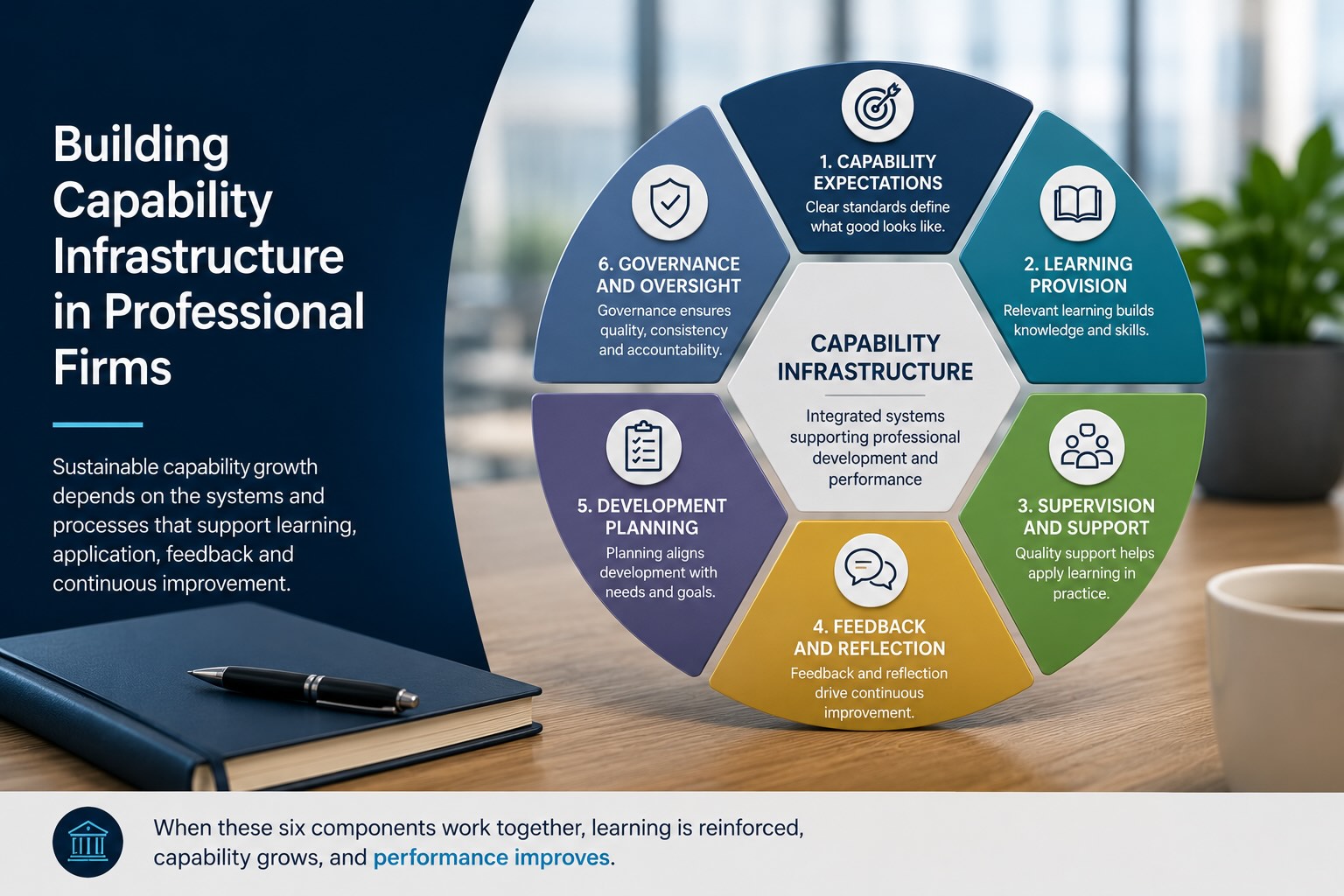
Building Capability Infrastructure in Professional Firms
Next Article

What Law Firms Need Beyond CPD Tracking
Explore Related Topics

Mapping Your Learning & Development To The SRA Statement of Solicitor
Recommended Next Step
-
What Law Firms Need Beyond CPD Tracking
