
Tracking Competence Development Across the Training Lifecycle
Professional competence is often spoken about as something that is achieved on a particular day. A trainee qualifies, an assessment is passed or a certificate is issued.
In reality, that’s not how professional development works. A solicitor’s knowledge, judgement and practical skills continue to develop throughout their career. Every client matter, supervision meeting, piece of feedback and reflective discussion contributes to that experience. Some lessons come from formal learning, others from dealing with unfamiliar situations or working alongside more experienced colleagues. Competence grows over time. Tracking it should reflect that reality rather than relying on occasional assessments or annual reviews.
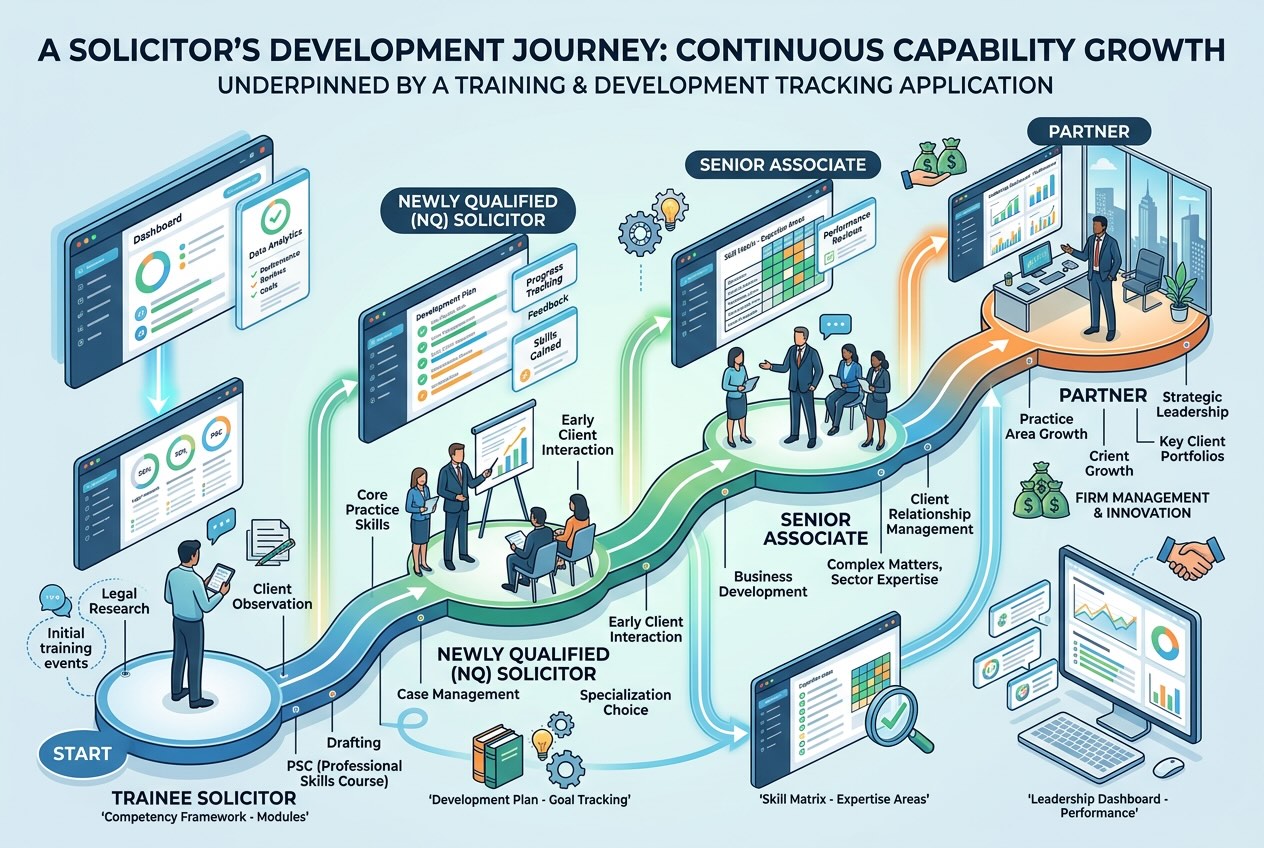
Viewing Development as a Continuous Journey
The development of a legal professional begins long before qualification and continues well beyond it. Recruitment and selection identify potential while establishing the standards and behaviours expected from the outset.
From there, new joiners begin to understand their firm through induction and onboarding. Initial learning provides the legal knowledge needed to start work, while confidence develops through applying that learning in practice under appropriate supervision.
As experience grows, so does professional judgement. Individuals become more independent, take responsibility for increasingly complex work and begin to develop specialist expertise. Qualification is only one stage in a wider process that includes continuing competence, career progression and, for many, future leadership responsibilities.
Recognising that development takes place throughout an individual’s career enables firms to provide the right support at the right time.
Why Tracking Matters
Most firms already collect a considerable amount of information about their people. The difficulty is that it is often held in different places.
Learning records may sit within a learning management system. Supervision notes may be recorded separately. Appraisal documentation is frequently held by HR, while informal coaching conversations often disappear once they have taken place. Each source provides part of the picture, but none tells the whole story on its own.
When these records are brought together, patterns begin to emerge. Supervisors can see how an individual has developed over several years rather than reviewing isolated snapshots. Strengths become easier to recognise, recurring development needs are easier to identify and support can be provided before small issues become larger ones.
Good competence tracking is not about collecting more information. It is about connecting the information that firms already have.
Evidence Builds Confidence
Competence is demonstrated through consistent performance over time rather than a single assessment.
Formal learning remains important because it develops knowledge and introduces new ideas. Equally valuable are the conversations that take place during supervision, the observations made while work is being completed and the reflections that follow challenging pieces of work. Feedback from colleagues, clients and managers all contributes to understanding how someone performs in practice.
Development plans and capability reviews add further context by showing how individuals respond to feedback and whether identified learning needs are being addressed.
Viewed together, these different sources of evidence provide a balanced and credible picture of professional competence. Individual pieces of evidence may tell part of the story; collectively, they demonstrate how someone is developing throughout their career.
Supporting Supervisors
Supervision is considerably easier when managers have access to a clear record of development.
Rather than relying on memory or the most recent appraisal, supervisors can see how an individual has progressed over time. They can identify areas where confidence is growing, recognise recurring themes that may require further support and judge whether someone is ready to take on more demanding work.
This changes the quality of supervision discussions. Conversations become more focused because they are based on evidence rather than impressions. Feedback can be linked to previous objectives, progress becomes easier to measure and development plans are more likely to reflect what individuals genuinely need.
For supervisors responsible for several team members, having that continuity is particularly valuable.
Linking Learning and Practice
One of the biggest challenges in professional development is demonstrating that learning has made a difference.
Attendance at a training session tells us very little on its own. The more important question is what happens afterwards. Has the individual started applying that knowledge in day-to-day work? Are decisions becoming more consistent? Is confidence increasing when dealing with unfamiliar situations? Have previous capability gaps begun to reduce?
These are the questions that matter because they focus on changes in professional practice rather than simply measuring participation in learning activities.
When competence is tracked over time, firms are far better placed to understand whether learning is influencing behaviour and ultimately improving the service provided to clients.
From Individual Development to Organisational Capability
Although competence develops at an individual level, the benefits of tracking it extend across the firm.
Senior leaders gain a clearer understanding of the strengths that already exist within the workforce and where additional investment in development may be needed. Workforce planning becomes more informed because future capability can be assessed using evidence rather than assumption. Consistent records also make it easier to demonstrate that supervision arrangements are working effectively and that professional standards are being maintained.
More importantly, firms begin to see competence as more than an individual responsibility. When development information is viewed collectively, it provides insight into organisational capability, highlights emerging risks and supports better strategic decision-making.
Competence tracking therefore becomes an important part of governance rather than simply another compliance activity.
Getting Started
Most firms already possess much of the evidence needed to understand professional competence more effectively. The challenge is rarely collecting more information; it is creating a coherent framework that brings existing evidence together.
Some practical starting points could be to:
- identify where competence evidence is currently held
- establish a consistent approach to supervision records and development conversations
- connect learning, supervision and appraisal information wherever possible
- review competence trends over time rather than as isolated events
- use competence evidence to inform development planning and workforce decisions.
Small improvements in how evidence is brought together can significantly improve both supervision and organisational understanding.
Preparing for Lifelong Professional Development
The legal profession never stands still. Legislation changes, regulation evolves, technology reshapes legal practice and client expectations continue to rise.
Professionals need opportunities to develop new skills and adapt throughout their careers.
A consistent approach to competence tracking helps individuals understand their own progress while giving firms confidence that learning continues to keep pace with the demands of modern professional practice.
Looking Ahead
Many firms already possess the information needed to understand competence more effectively. The challenge has traditionally been bringing it together.
Modern digital platforms are beginning to overcome that problem by combining learning records, supervision evidence, appraisal information and reflective practice into a single record of professional development. Instead of searching across multiple systems, professionals, supervisors and organisational leaders can see how competence has evolved over time and use that information to guide future development.
As these systems continue to mature, competence tracking will become an integral part of professional development, workforce planning and organisational governance rather than an administrative exercise undertaken solely for compliance purposes.
Conclusion
Competence develops through experience, learning, supervision and reflection over the course of an entire career.
Firms that monitor that development consistently are better placed to support their people, identify emerging capability needs and demonstrate that professional standards are being maintained. Supervisors gain a clearer understanding of individual progress and leaders are able to make better-informed decisions about learning and future capability.
Ultimately, effective competence tracking is about far more than generating records or satisfying regulatory requirements. It enables firms to understand how professionals develop, recognise where support is needed and build stronger organisational capability through better supervision, informed leadership and evidence-based governance.
CONTINUE READING
Read Other Articles in This Series
Previous Article

Governance Models for Professional Skills Development
Next Article

Explore Related Topics

Continuing Competence: The First Six Months
Recommended Next Step
-
Governance Models for Professional Skills Development
