
Building an Audit Trail for Continuing Competence
Introduction
Continuing competence is no longer simply about completing learning activities. Across the legal profession, expectations have evolved towards demonstrating that solicitors remain capable of delivering competent legal services throughout their careers.
This shift has profound implications for law firms.
While individual solicitors remain responsible for maintaining their competence, firms increasingly need to demonstrate that they have effective systems to support, monitor and oversee professional development. The challenge is no longer collecting training records—it is creating a reliable evidence base that shows competence is being actively maintained.
Many firms possess large amounts of information relating to learning, supervision, file reviews, appraisals and compliance. Unfortunately, these records often exist in separate systems, making it difficult to demonstrate a coherent picture of continuing competence.
An audit trail addresses this problem.
Rather than being a collection of disconnected documents, an effective audit trail creates a structured record that links professional development, workplace performance, supervisory oversight and governance decisions. It provides evidence not only that learning has taken place, but also that competence has been considered, reviewed and supported over time.
For regulators, leadership teams and clients alike, this distinction is becoming increasingly important.
What Is an Audit Trail?
An audit trail is a chronological record that demonstrates how competence has been developed, reviewed, evidenced and supported throughout a solicitor’s professional practice.
Unlike a simple CPD log, an audit trail connects multiple sources of evidence into a coherent narrative.
These sources may include:
- learning activities
- reflective practice
- supervision discussions
- file reviews
- client feedback
- quality assurance findings
- annual appraisals
- competency assessments
- development plans
- regulatory declarations
Together, these records provide assurance that competence has not been assumed but actively managed.
An audit trail therefore demonstrates process, oversight and continuous improvement rather than simply documenting attendance at training events.
Why Evidence Matters
Regulators increasingly focus on outcomes rather than activities.
A solicitor may have attended numerous training sessions during the year, yet if those activities have little impact on professional performance, they provide limited assurance of continuing competence.
Conversely, a solicitor who identifies a knowledge gap, discusses it with their supervisor, undertakes targeted learning, applies the learning in practice and subsequently demonstrates improved performance creates a compelling evidence trail.
The second example tells a complete story.
It shows:
- self-awareness
- professional reflection
- supported development
- practical application
- supervisory oversight
- measurable improvement
This is precisely the type of evidence that competence governance seeks to capture.
From Records to Assurance
Many firms already hold most of the information needed to create an audit trail.
The challenge lies in connecting the evidence.
For example, a learning record should not exist in isolation.
Instead, it should relate to:
- why the learning was required
- the competence risk identified
- supervisory discussions
- workplace application
- subsequent review
- ongoing monitoring
Each stage strengthens the evidence available to both the individual and the organisation.
Leadership therefore gains confidence that competence is being managed rather than simply recorded.
The Building Blocks of an Effective Audit Trail
An effective competence audit trail is typically built from six complementary evidence sources.
1. Learning Records
Formal learning remains important.
Courses, webinars, conferences and structured programmes provide evidence that development opportunities have been undertaken.
However, these records should identify the competence need being addressed rather than simply listing attendance.
2. Reflective Practice
Reflection demonstrates professional judgement.
Solicitors should be encouraged to record:
- what they learned
- why it matters
- how it will influence future practice
- what further development may be required
Reflection transforms learning into professional growth.
3. Workplace Evidence
Competence is demonstrated in practice.
Useful evidence may include:
- file reviews
- matter audits
- observed practice
- peer feedback
- client outcomes
- supervision notes
These provide tangible evidence that learning has translated into improved professional performance.
4. Supervisory Oversight
Supervisors play a critical role in competence assurance.
Regular discussions help confirm:
- capability
- confidence
- emerging risks
- additional support needs
- development priorities
Documented supervision strengthens both individual and organisational assurance.
5. Organisational Review
Firms should periodically analyse competence information across teams.
Questions might include:
- Are particular departments experiencing recurring issues?
- Are similar learning needs appearing across multiple practice areas?
- Are supervisory concerns increasing?
- Are regulatory risks emerging?
This transforms individual records into strategic management information.
6. Governance Reporting
The final stage is governance.
Leadership requires clear reporting that enables informed decision-making.
Typical reports may summarise:
- competence trends
- development activity
- supervision outcomes
- outstanding risks
- compliance indicators
- organisational capability
This ensures competence becomes part of routine governance rather than remaining an operational activity.
Avoiding Common Weaknesses
Many competence records fail because they focus on administration rather than evidence.
Common weaknesses include:
- recording attendance without outcomes
- storing evidence in disconnected systems
- inconsistent supervision documentation
- relying entirely upon annual declarations
- collecting information that is never reviewed
- failing to identify organisational trends
Each of these limits the value of the audit trail.
The objective is not simply to accumulate documents but to create evidence that supports informed judgement.
Digital Competence Governance
Modern competence governance increasingly relies upon integrated digital systems.
Rather than maintaining separate spreadsheets and isolated databases, organisations are moving towards platforms that combine:
- competence records
- supervision documentation
- learning management
- reflective practice
- governance reporting
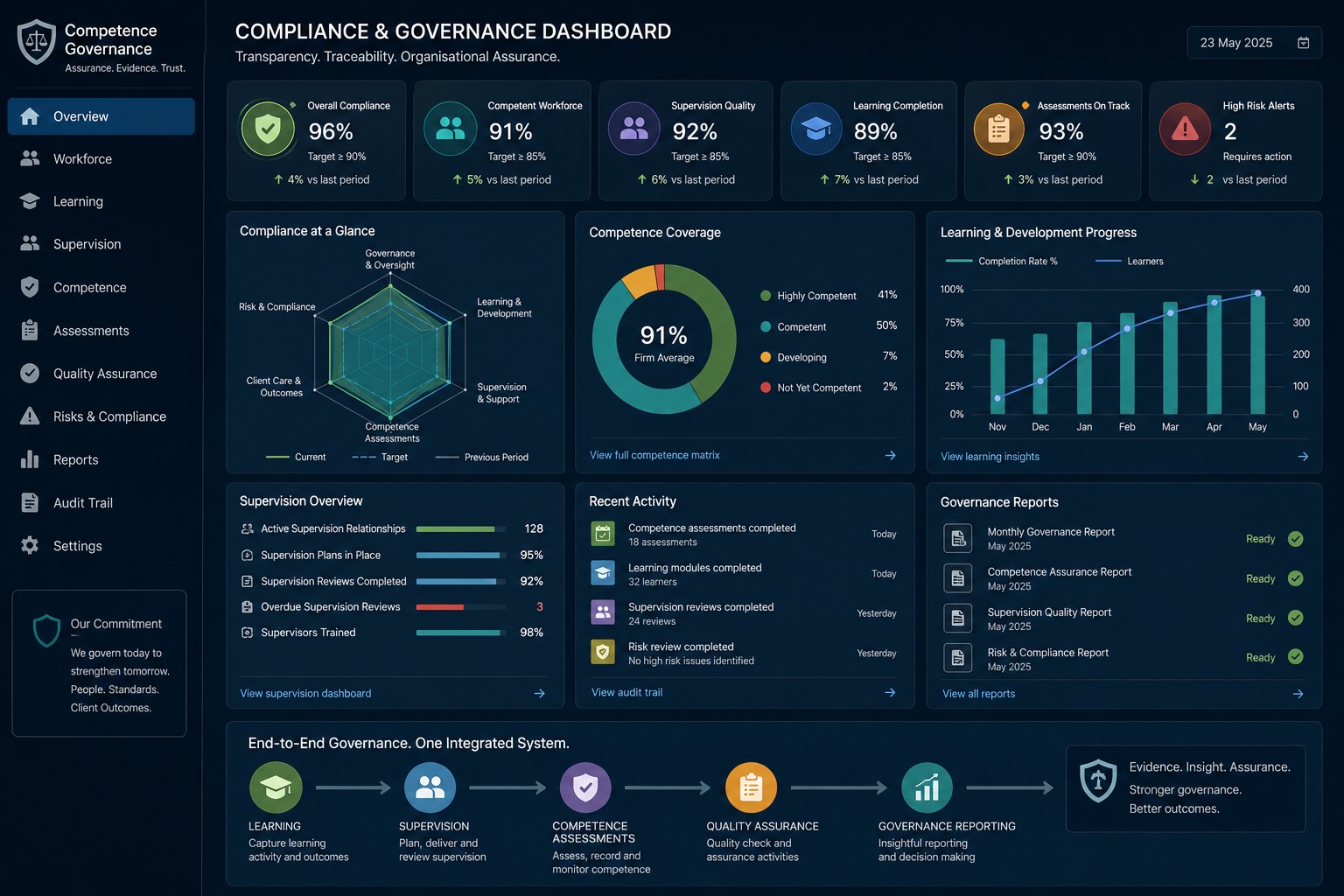
- organisational dashboards
This integration improves consistency, reduces duplication and provides leadership with real-time oversight of competence across the organisation.
It also enables firms to demonstrate governance more effectively during regulatory engagement.
Building an Audit Trail in Practice
Developing an audit trail should be viewed as an ongoing process rather than a one-off compliance exercise.
A practical implementation programme typically includes:
- Identify all existing competence evidence.
- Define organisational competence standards.
- Standardise supervisory documentation.
- Introduce structured reflection.
- Connect learning records to competence outcomes.
- Develop governance reporting.
- Review trends regularly.
- Continuously refine the evidence base.
Over time, this creates an increasingly mature competence governance system that supports both regulatory assurance and organisational performance.
Key Takeaways
- Continuing competence requires evidence rather than assumptions.
- An audit trail links learning, supervision, reflection and workplace performance.
- Integrated evidence provides stronger organisational assurance.
- Leadership benefits from improved visibility of competence risks and capability trends.
- Well-designed audit trails support both regulatory compliance and strategic decision-making.
Conclusion
An effective audit trail is not simply a compliance record. It is a governance tool that enables organisations to understand, evidence and continually improve professional competence.
By connecting learning, supervision, workplace performance and governance into a coherent evidence framework, firms create confidence for regulators, reassurance for leadership and better support for their people.
As expectations surrounding continuing competence continue to evolve, organisations with mature audit trails will be far better positioned to demonstrate that competence is not merely encouraged—it is systematically governed.
CONTINUE READING
Read Other Articles in This Series
Previous Article

Managing Continuing Competence Across Teams
Next Article

Competence Dashboards for Law Firms
Explore Related Topics

Competence Records: What Good Looks Like
Recommended Next Step
Evidence-Based Annual Declarations
