
Managing Continuing Competence Across Teams

Introduction
Continuing competence is often viewed as an individual professional responsibility. Solicitors are expected to identify their learning needs, undertake appropriate development and reflect on their practice throughout their careers. These remain fundamental principles of professional development but they represent only part of the picture.
Legal services are delivered by teams, not by individuals working in isolation. The quality of legal services depends on the collective capability of the team as well as the competence of each individual lawyer.
This creates an important leadership challenge. Firms must not only support individual professional development but also ensure that competence is developed consistently across different teams, areas of practice and levels of experience. Achieving that consistency requires a coordinated approach to competence governance that aligns professional development with the wider needs of the firm.
From Individual Competence to Team Capability
An individual solicitor may be highly competent but the firm’s performance depends upon much more than individual expertise.
Successful teams also require:
- Effective supervision
- Shared knowledge
- Consistent professional standards
- Collaborative learning
- Appropriate resourcing
- Leadership
- Succession planning
- Continual improvement.
Competence therefore becomes a collective capability rather than merely an individual attribute. Leadership must be confident that individuals remain competent and that teams possess the combined capability required to deliver consistently high-quality legal services.
Why Team-Based Competence Matters
Managing competence at team level provides a broader understanding of organisational performance.
Leadership can identify questions such as:
- Does this practice area possess sufficient specialist expertise?
- Are supervisors able to support junior colleagues effectively?
- Are similar capability gaps emerging across multiple teams?
- Where should learning investment be prioritised?
- Are future leadership pipelines developing as expected?
These questions cannot be answered through individual learning records – they require an organisational perspective.
The Challenge of Consistency
Every practice area develops its own culture, priorities and ways of working. That flexibility is both natural and necessary, reflecting the different demands of clients and areas of law. However, it can also result in inconsistent approaches to supervision, appraisal, reflective practice and professional development, making it difficult to assess competence consistently across the firm.
A coordinated approach to competence governance provides a common framework while allowing individual teams the flexibility to meet their own operational needs. This gives leadership greater confidence that professional standards are being applied consistently and that capability can be understood more accurately.
Building a Team-Based Competence Framework
Managing competence across teams does not require identical development plans or uniform learning programmes. Firms should establish consistent governance principles while allowing implementation to reflect operational needs.
An effective framework typically includes five elements.
1. Shared Competence Standards
The firm should define the professional capabilities expected across comparable roles. These standards provide consistency while recognising practice-specific expertise.
2. Consistent Supervision
Every team should operate within agreed supervisory principles. Although supervisory styles may differ, expectations regarding coaching, feedback, reflection and evidence should remain consistent.
3. Coordinated Learning
Learning priorities should reflect both individual development needs and organisational capability requirements. This ensures investment supports strategic business objectives rather than isolated interests.
4. Organisational Oversight
Leadership should periodically review competence information across all practice areas. This enables comparison, trend analysis and early identification of risks.
5. Continuous Improvement
Teams should regularly share learning, successful practices and supervisory approaches. Knowledge exchange strengthens capability while reducing duplication of effort.
The Role of Partners
Partners occupy a critical position within competence governance. They understand the practical realities of their departments while also contributing to wider organisational leadership.
Their responsibilities include:
- Supporting supervision
- Identifying capability risks
- Encouraging reflective practice
- Developing future specialists
- Promoting knowledge sharing
- Contributing to governance reporting
They act as the connection between individual development and organisational strategy.
Measuring Team Capability
Traditional measures of professional development tend to focus on individual activity, such as completed training or appraisal outcomes. Competence governance takes a broader view by considering how effectively teams develop, apply and sustain professional capability over time.
Leadership should therefore look beyond individual records and consider wider indicators, including supervisory confidence, quality assurance outcomes, client satisfaction, recurring development needs, succession readiness and the resilience of teams during periods of change. Together, these measures provide a more complete understanding of organisational capability and help identify where further development or support may be needed.
Learning Across Teams
One of the greatest benefits of firm-wide competence governance is the ability to share learning across the firm. Effective supervision approaches developed within one team can be adopted more widely, while insights from specialist departments and lessons learned from significant matters can inform professional practice across other areas of the business.
This creates a culture in which knowledge is shared rather than retained within individual teams. As a result, competence becomes an asset that strengthens capability, improves consistency and supports continuous improvement across the firm.
Managing Change Across the Organisation
Law firms continually adapt to:
- Legislative reform
- Regulatory change
- Technological innovation
- Changing client expectations
- New service offerings
Managing competence across teams enables organisations to coordinate these transitions more effectively.
Leadership can identify:
- Where new knowledge is required
- Which teams require additional support
- How capability is developing
- Whether organisational readiness is improving.
This creates greater confidence during periods of change.
Competence Governance in Practice
Firms with mature competence governance typically combine:
- Structured supervision
- Meaningful development planning
- Reflective practice
- Evidence-based reviews
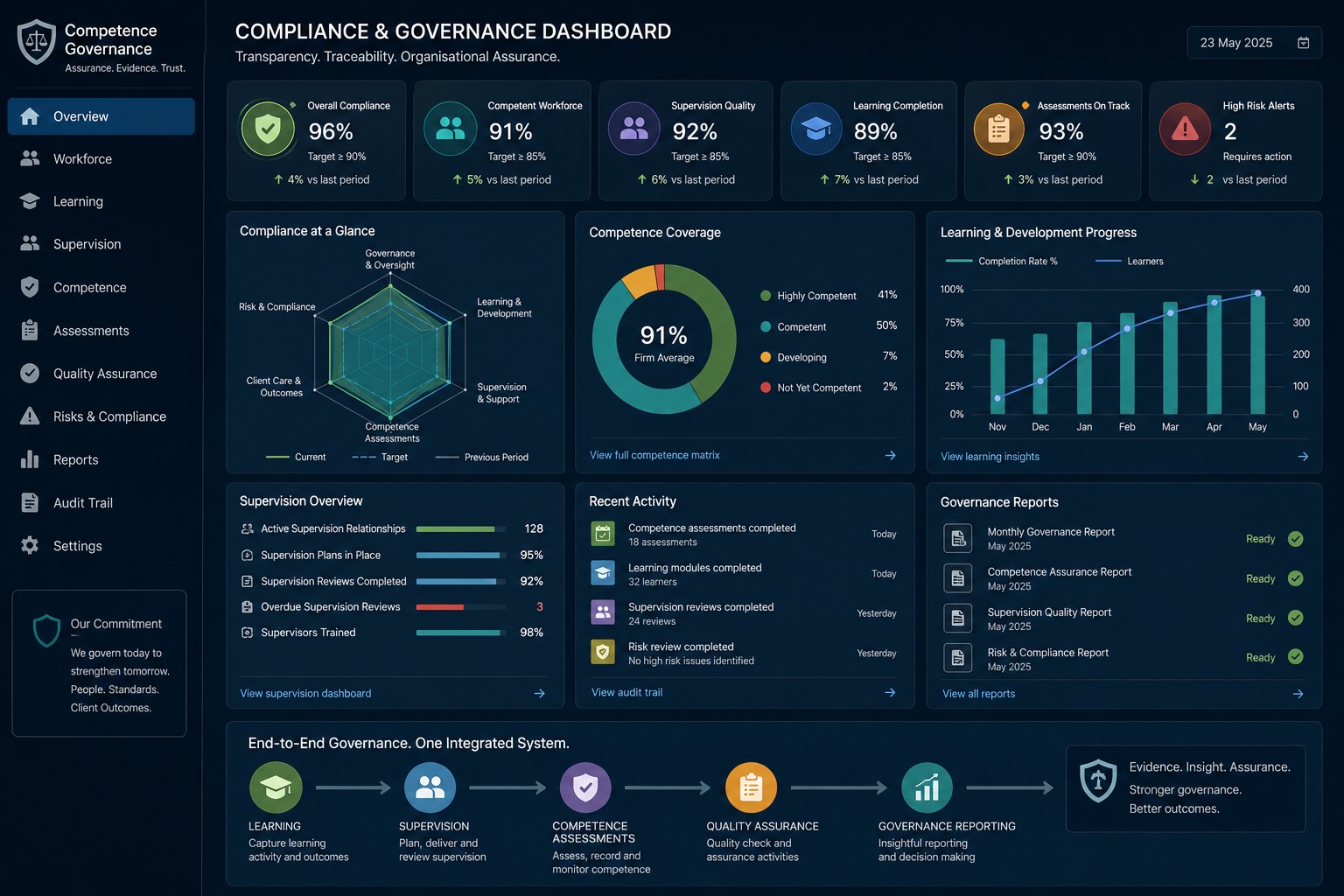
- Competence dashboards
- Leadership reporting
Together these provide visibility of capability across the organisation while supporting individual professional growth. Rather than monitoring competence team by team in isolation, leadership gains a comprehensive view of organisational capability.
Looking Beyond Departments
Ultimately, competence governance encourages organisations to think beyond departmental structures. The objective is not simply to maintain strong individual teams. It is to build an organisation capable of consistently delivering professional excellence regardless of where work originates or how services evolve.
This broader perspective strengthens resilience, improves collaboration and supports sustainable organisational growth.
Key Takeaways
- Competence should be managed across teams as well as at individual level.
- Consistent governance strengthens organisational capability while allowing operational flexibility.
- Team leaders play a vital role in connecting supervision, development and organisational governance.
- Cross-team learning improves professional standards and organisational resilience.
- Competence governance enables leadership to understand capability across the entire firm rather than within isolated departments.
Conclusion
Continuing competence begins with individual responsibility but reaches its full value when firms manage capability across teams.
By establishing shared standards, consistent supervision, coordinated learning and effective organisational oversight, firms can create environments where competence becomes a collective strength rather than an individual achievement. Managing competence across teams enables leadership to identify risks earlier, invest more effectively in professional development and build organisations capable of adapting to changing legal, regulatory and commercial demands.
Ultimately, the firms that succeed will not simply employ competent individuals. They will build competent teams that work together to deliver consistently outstanding legal services.
CONTINUE READING
Read Other Articles in This Series
Previous Article

Evidence-Based Competence Management
Next Article
Building an Audit Trail for Continuing Competence
Explore Related Topics

Competence Records: What Good Looks Like
Recommended Next Step

The SRA is revisiting continuing competence
