
Designing a Competence Governance System
Introduction
Every law firm already possesses elements of a competence governance system.
Learning and development programmes support professional growth.
Supervisors review work and provide guidance.
Annual appraisals encourage reflection.
Quality assurance processes monitor standards.
Compliance teams oversee regulatory obligations.
Leadership makes strategic decisions about capability, recruitment and organisational development.
The challenge is not the absence of these activities.
The challenge is that they frequently operate as separate processes.
Information remains within individual departments.
Responsibilities become fragmented.
Professional development, supervision, compliance and governance often evolve independently despite pursuing the same objective: ensuring that people remain competent to deliver safe, ethical and high-quality legal services.
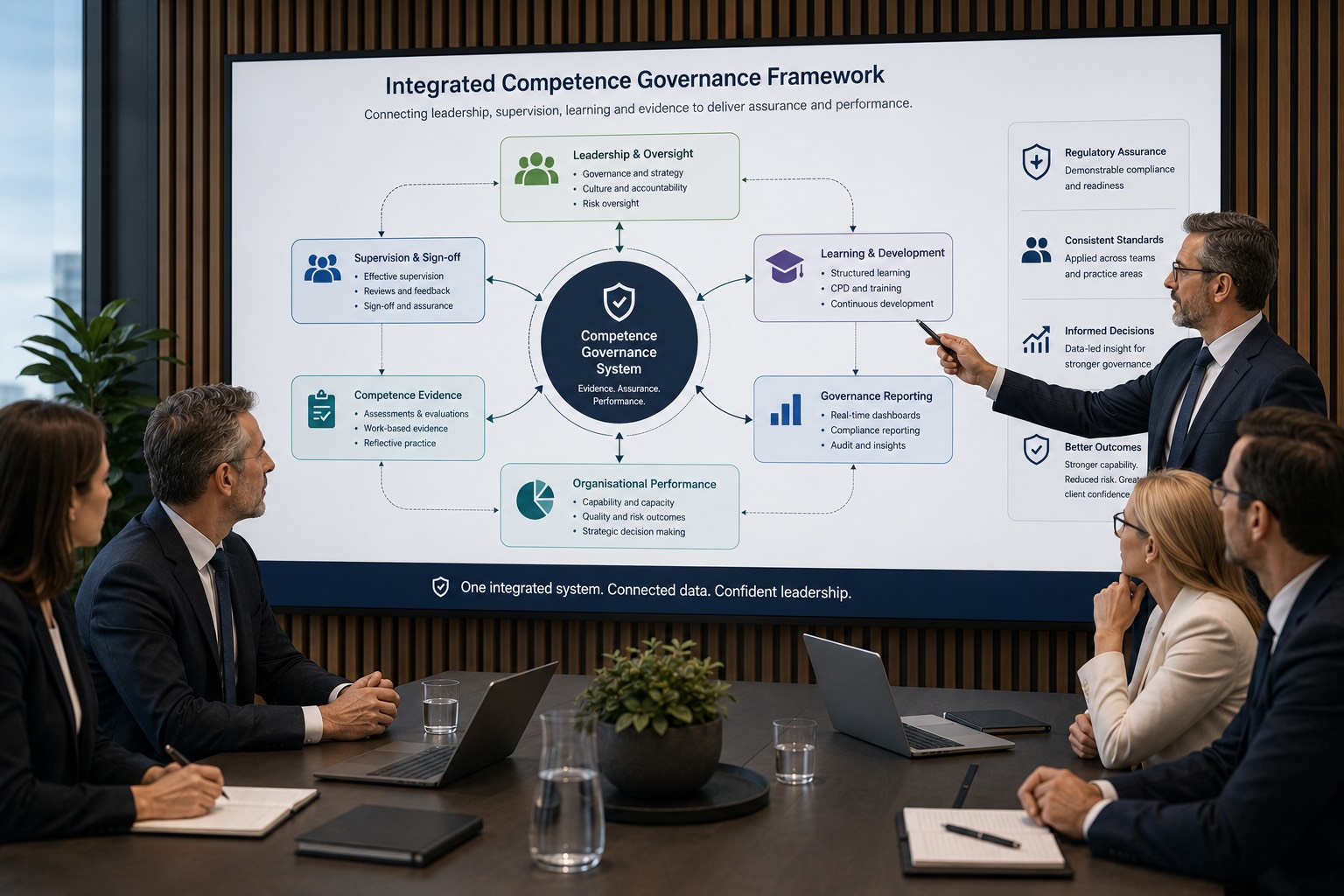
A competence governance system brings these activities together.
Rather than creating another process, it integrates existing processes into a single organisational framework that enables leadership to understand, support and continually improve professional capability across the firm.
Done well, a competence governance system becomes an integral part of organisational management rather than simply another compliance initiative.
Why Firms Need a System
Competence does not exist in isolation.
It develops through the interaction of people, leadership, supervision, learning and organisational culture.
If these activities are disconnected, important information is often lost.
For example:
A supervisor may identify a recurring knowledge gap.
Learning and Development may organise relevant training.
Quality assurance may subsequently identify improvements.
However, unless these activities are connected, leadership gains only a fragmented understanding of organisational capability.
A governance system provides that connection.
It enables firms to see competence as a living organisational system rather than a collection of independent activities.
Thinking in Systems Rather Than Processes
Many organisations naturally think in terms of individual processes.
Training.
Appraisals.
Supervision.
Compliance.
Each process performs well within its own area.
However, competence is influenced by the relationships between them.
A systems approach asks different questions.
How does supervision inform learning?
How does learning improve professional performance?
How is competence evidenced?
How is evidence reported to leadership?
How are organisational risks identified?
How are future capability needs planned?
These connections define an effective competence governance system.
The Six Components of a Competence Governance System
Although every organisation will develop its own model, successful systems generally include six integrated components.
1. Leadership and Governance
Leadership establishes the organisational commitment to competence.
Responsibilities include:
- defining strategic expectations;
- allocating resources;
- reviewing organisational capability;
- supporting continual improvement;
- ensuring governance remains effective.
Competence therefore becomes a board-level consideration rather than an operational activity alone.
2. Competence Frameworks
Organisations require clear definitions of competent professional practice.
Frameworks should describe expectations relating to:
- legal knowledge;
- professional skills;
- ethical behaviour;
- supervision;
- leadership;
- communication;
- client service.
Clear standards provide consistency across teams while supporting meaningful development conversations.
3. Professional Development
Learning remains one of the principal mechanisms through which competence develops.
Development should include:
- structured learning;
- workplace experience;
- coaching;
- mentoring;
- reflective practice;
- professional discussion;
- knowledge sharing.
Professional development becomes purposeful when aligned to identified competence needs rather than generic learning activity.
4. Supervision and Support
Supervision provides the connection between learning and professional practice.
Effective supervisors:
- observe performance;
- encourage reflection;
- provide coaching;
- identify capability gaps;
- support confidence;
- document professional development.
Supervision therefore becomes one of the richest sources of competence evidence.
5. Evidence and Assurance
Leadership requires confidence that competence is genuinely being maintained.
Evidence may include:
- learning records;
- reflective practice;
- supervision notes;
- file reviews;
- quality assurance;
- client feedback;
- annual declarations;
- competence assessments.
Multiple evidence sources provide stronger organisational assurance than any single measure alone.
6. Organisational Intelligence
The final component transforms operational evidence into strategic management information.
Competence dashboards, governance reports and trend analysis enable leadership to understand:
- organisational capability;
- emerging risks;
- development priorities;
- succession readiness;
- future investment requirements.
This intelligence supports informed decision-making.
Integrating Existing Systems
One of the greatest misconceptions surrounding competence governance is that firms must implement entirely new systems.
In reality, most organisations already possess the necessary building blocks.
The objective is integration.
Rather than replacing existing processes, organisations should connect them through consistent governance principles.
Learning informs supervision.
Supervision generates evidence.
Evidence supports governance.
Governance influences organisational strategy.
Each activity strengthens the next.
Designing for Proportionality
Competence governance should always reflect the nature of the organisation.
A small specialist practice requires different arrangements from an international law firm.
However, the underlying principles remain consistent.
Every organisation should be able to answer:
- What competence do we expect?
- How is competence supported?
- How is competence evidenced?
- How is competence reviewed?
- How do we improve organisational capability?
The answers may differ, but the questions remain the same.
Building the System
Implementation is best viewed as a programme of continual improvement rather than a single project.
A practical approach may include:
Step 1 — Review Existing Arrangements
Identify current learning, supervision, appraisal and governance processes.
Step 2 — Define Competence Expectations
Develop consistent competence standards across comparable roles.
Step 3 — Align Professional Development
Ensure learning activities support identified capability requirements.
Step 4 — Strengthen Supervision
Develop supervisors as coaches, mentors and competence assessors.
Step 5 — Integrate Evidence
Connect learning records, supervision, quality assurance and reflective practice.
Step 6 — Develop Governance Reporting
Introduce dashboards and management information that support leadership decisions.
Step 7 — Review and Improve
Competence governance should evolve continually in response to organisational learning, regulatory developments and changing business priorities.
Technology as an Enabler
Modern competence governance increasingly relies upon integrated digital systems.
Technology should simplify governance rather than increase administration.
Effective platforms help organisations:
- maintain competence records;
- manage development plans;
- support supervision;
- capture evidence;
- produce dashboards;
- identify organisational trends.
Importantly, technology supports governance—it does not replace leadership.
Good governance always depends upon thoughtful professional judgement.
The Benefits of an Integrated System
Organisations implementing integrated competence governance systems often experience improvements across multiple areas.
These include:
- stronger professional standards;
- better supervision;
- improved regulatory assurance;
- more effective learning investment;
- earlier identification of capability risks;
- stronger succession planning;
- increased organisational resilience;
- enhanced client confidence.
Competence therefore becomes both a governance function and a strategic organisational capability.
Looking to the Future
The legal profession is entering an era where competence will increasingly be viewed as an organisational capability requiring structured governance.
Artificial intelligence, evolving regulation, new service models and changing client expectations will all demand more sophisticated approaches to capability management.
Organisations that establish integrated competence governance systems today will be significantly better prepared for these future challenges.
More importantly, they will create environments where professionals continue learning, supervisors develop stronger teams and leadership gains the confidence required to guide sustainable organisational growth.
Key Takeaways
- Competence governance systems integrate existing organisational processes rather than creating additional bureaucracy.
- Leadership, supervision, learning, evidence and governance should operate as a connected management system.
- Organisational intelligence transforms competence evidence into informed strategic decision-making.
- Effective systems remain proportionate to the size and complexity of the organisation.
- Integrated governance strengthens professional capability, regulatory assurance and long-term organisational performance.
Conclusion
Designing a competence governance system is not about introducing another layer of administration.
It is about connecting the activities that already exist within most law firms into a coherent framework that supports continual professional development, effective supervision and informed organisational leadership.
By integrating competence standards, learning, supervision, evidence and governance, firms create systems capable of responding confidently to regulatory expectations while continually strengthening organisational capability.
Ultimately, competence governance succeeds because it places professional capability at the centre of organisational management.
Rather than treating competence as an isolated compliance obligation, it becomes a strategic organisational asset that supports better decisions, stronger leadership and consistently higher standards of legal service.
CONTINUE READING
Read Other Articles in This Series
Previous Article

Why Professional Development Infrastructure Matters More Than Training Delivery
Next Article
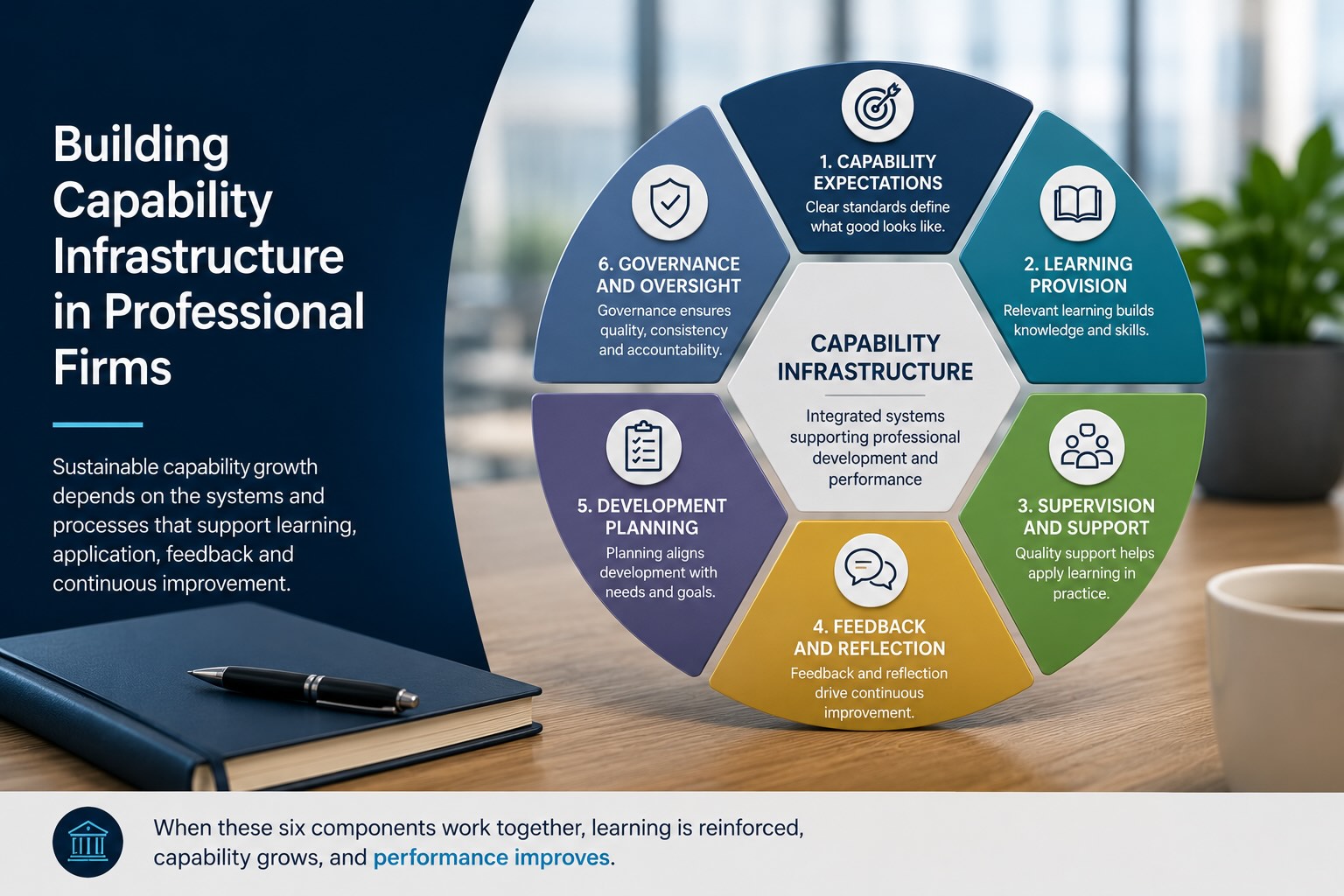
Building Capability Infrastructure in Professional Firms
Explore Related Topics

The SRA is revisiting continuing competence
Recommended Next Step

Competence Dashboards for Law Firms
