
Governance Models for Professional Skills Development
Professional skills development delivers its greatest value when it is actively governed rather than simply administered. Discover how effective governance models align learning, supervision, leadership and organisational strategy to create consistently capable legal professionals and stronger law firms.

Introduction
Most law firms invest significantly in professional development; training programmes are delivered, learning platforms are introduced, development plans are created, professional skills are discussed during appraisals and supervision meetings. Yet despite this investment, many firms struggle to answer a fundamental question.
How do we know our professional skills strategy is actually working?
Attendance statistics provide only part of the answer. Course completion rates tell us little about behavioural change. Even positive feedback from delegates does not necessarily demonstrate improved professional performance.
Developing professional skills requires more than effective learning. It requires effective governance. Governance ensures that professional development is aligned with organisational priorities, supported by leadership, reinforced through supervision and continually evaluated for its impact on both individuals and the firm.
Rather than treating learning as an isolated function, governance places professional skills development at the centre of organisational capability.
Why Governance Matters
Professional skills influence almost every aspect of legal practice. The way lawyers at all levels communicate with clients, exercise professional judgement, demonstrate leadership, build commercial awareness and make ethical decisions has a direct impact on the quality of legal services and the performance of the firm as a whole.
For that reason, professional skills should not be viewed solely as the responsibility of L&D. They are a strategic organisational asset that deserves the same level of oversight as any other capability critical to business performance. Leadership therefore has a legitimate interest in understanding how professional capability is developing across the firm, where strengths are emerging and where additional support or investment may be required
Moving Beyond Learning Administration
Traditional learning management often concentrates on administration.
Typical reports include:
- training attendance;
- course completion;
- mandatory learning;
- CPD activity.
These remain useful but governance asks broader questions.
For example:
- Are professional skills improving?
- How effective is supervision?
- Which teams require additional development?
- Where are capability risks emerging?
- How does learning support organisational strategy?
These questions provide meaningful organisational insight.
The Components of an Effective Governance Model
Successful governance models integrate several organisational functions.
Leadership
Leadership establishes priorities, allocates resources and reinforces the importance of continual professional development. Without visible leadership support, learning initiatives often lose momentum.
Learning and Development
Learning professionals design programmes that develop the capabilities required by the firm, and ensure learning remains relevant, practical and aligned with strategic objectives.
Supervision
Supervisors reinforce learning through:
- coaching;
- workplace observation;
- professional discussion;
- constructive feedback;
- reflective conversations.
They provide valuable evidence that learning is influencing professional behaviour.
Professional Development Planning
Individual development plans connect organisational priorities with personal career aspirations, providing structure while encouraging ownership of professional growth.
Governance Reporting
Leadership requires meaningful information regarding:
- organisational capability;
- learning effectiveness;
- supervision quality;
- emerging development priorities;
- professional skills trends.
Governance reporting transforms development activity into strategic organisational intelligence.
Aligning Learning with Organisational Strategy
Professional development is most effective when it supports the wider objectives of the firm rather than operating as an isolated learning activity. As firms evolve, they need their people to develop the capabilities to help achieve strategic priorities, whether that means improving client service, strengthening supervision, preparing future leaders, supporting digital transformation or building greater commercial awareness.
When learning is aligned with organisational strategy, investment in professional development delivers far greater value. Professional skills become more than individual learning outcomes; they become drivers of improved performance and long-term business success.
Evidence Supports Better Decisions
Governance depends upon evidence rather than assumption.
Useful evidence may include:
- supervisor observations;
- reflective discussions;
- development reviews;
- client feedback;
- workplace performance;
- learning engagement;
- organisational capability trends.
Together these provide leadership with confidence that professional skills continue developing throughout the organisation.
Building Accountability
Effective governance relies on clear accountability. Leadership sets the strategic direction, learning teams develop capability programmes, supervisors reinforce development through everyday practice, and professionals take responsibility for their own learning.
When these responsibilities are clearly understood, professional development becomes a shared commitment rather than the responsibility of a single department. This strengthens organisational capability and supports long-term success.
Creating a Learning Organisation
Perhaps the greatest benefit of effective governance is the culture it creates. Learning becomes part of everyday life within the firm, with regular development conversations, shared knowledge and routine reflection supporting continuous improvement. Professional skills development is no longer seen as an occasional training initiative but as an integral part of how the firm grows and succeeds.
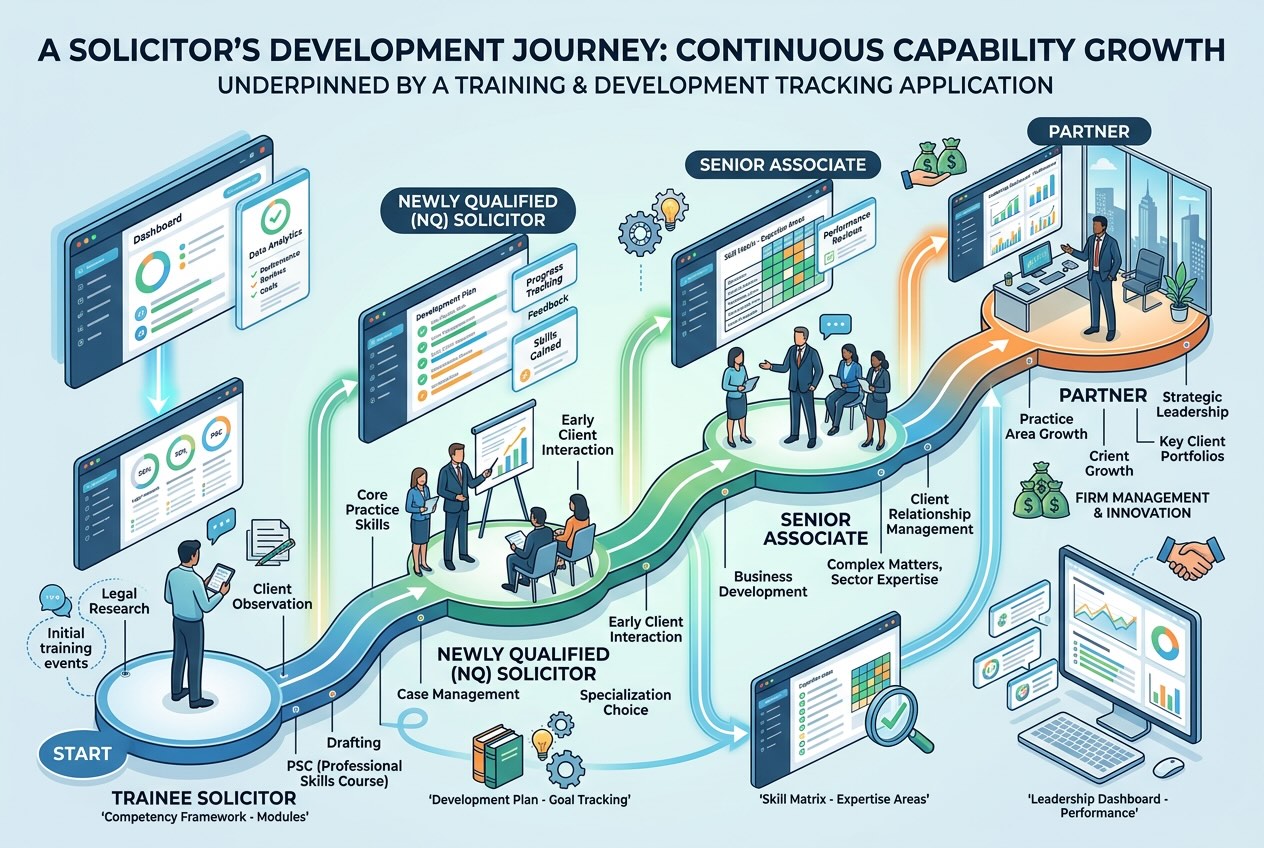
Technology Enables Better Governance
Modern learning and competence platforms provide leadership with valuable insight.
Integrated systems can connect:
- learning records;
- supervision;
- development plans;
- competence evidence;
- organisational dashboards.
Technology should support informed decision-making and reduce administrative effort.
Preparing for the Future
The legal profession continues to evolve as technology advances, client expectations change, regulation develops and new ways of working emerge. In this environment, professional capability has become a strategic asset rather than simply an individual responsibility.
Law firms that establish effective governance models today will be better placed to develop future professionals, respond confidently to change and build resilient organisations that continue to perform in an increasingly demanding environment.
Key Takeaways
- Professional skills development should be governed as a strategic organisational capability.
- Effective governance aligns learning, supervision, leadership and organisational objectives.
- Evidence-based reporting provides leadership with meaningful organisational insight.
- Shared accountability strengthens professional development across the organisation.
- Governance supports continual improvement while increasing organisational resilience.
Conclusion
Professional skills are among the most valuable assets any law firm possesses. Developing them successfully requires more than excellent training. It requires leadership commitment, effective supervision, meaningful evidence and governance that connects professional development with organisational strategy.
When these elements work together, professional skills become more than individual capabilities. They become part of the organisation’s collective strength.
Law firms that govern professional skills effectively create stronger learning cultures, more confident professionals, better client outcomes and greater organisational resilience.
Governance is not about controlling professional development. It is about ensuring that professional development consistently contributes to the long-term success of both individuals and the organisation.
CONTINUE READING
Read Other Articles in This Series
Previous Article

Building an Audit-Ready Continuing Competence Framework
Next Article
Tracking Competence Development Across the Training Lifecycle
Explore Related Topics

Continuing Competence: The First Six Months
Recommended Next Step
-
Tracking Competence Development Across the Training Lifecycle
