
Preparing for Regulatory Scrutiny

Introduction
Few phrases attract more attention within a law firm than “regulatory scrutiny.”
Whether prompted by a thematic review, a routine regulatory enquiry, a client complaint or an internal governance review, scrutiny often creates understandable concern.
Many organisations instinctively begin gathering documents.
Training records are checked.
Policies are reviewed.
Evidence is collected.
Annual declarations are revisited.
While these activities are entirely understandable, they also reveal an important weakness.
If competence evidence only begins to appear when scrutiny is anticipated, the organisation is responding rather than governing.
Well-governed firms take a different approach.
They do not prepare for regulatory scrutiny when scrutiny arrives.
They prepare continuously through effective competence governance.
The result is a significant shift in organisational confidence.
Instead of asking:
“Can we demonstrate competence?”
they ask:
“How would we like to present the evidence we already have?”
This distinction lies at the heart of modern competence governance.
Understanding Regulatory Scrutiny
Regulatory scrutiny should not be viewed solely as a response to organisational failure.
In many cases, regulators seek assurance that firms have appropriate systems supporting professional standards.
They are interested in understanding how organisations:
- support competence;
- supervise professionals;
- identify learning needs;
- manage organisational risk;
- promote continual improvement.
These questions extend beyond individual solicitors.
They increasingly examine the effectiveness of organisational governance.
Moving Beyond Documentation
Many firms naturally focus upon documentation.
Policies.
Training logs.
Attendance records.
Declarations.
While documentation remains important, it represents only one aspect of organisational assurance.
Regulators are increasingly interested in understanding how competence operates in practice.
For example:
- How are development needs identified?
- How does supervision support competence?
- How are capability concerns managed?
- How does leadership receive assurance?
- How does the organisation improve over time?
These questions require evidence of governance rather than documentation alone.
Preparing Every Day
The strongest preparation for regulatory scrutiny occurs during normal business operations.
Organisations should continually:
- support supervision;
- encourage reflective practice;
- maintain development plans;
- gather competence evidence;
- review organisational capability;
- strengthen governance processes.
When these activities become routine, regulatory preparation becomes significantly simpler.
Evidence already exists.
Leadership already understands organisational capability.
Professional conversations have already taken place.
The Role of Leadership
Leadership plays a critical role in regulatory readiness.
Partners and senior managers should be able to explain:
- how competence is governed;
- how supervision operates;
- how capability risks are identified;
- how organisational learning occurs;
- how improvement is monitored.
This confidence develops naturally when competence governance forms part of everyday organisational management.
Demonstrating Organisational Assurance
Regulatory confidence depends upon organisational assurance rather than isolated examples.
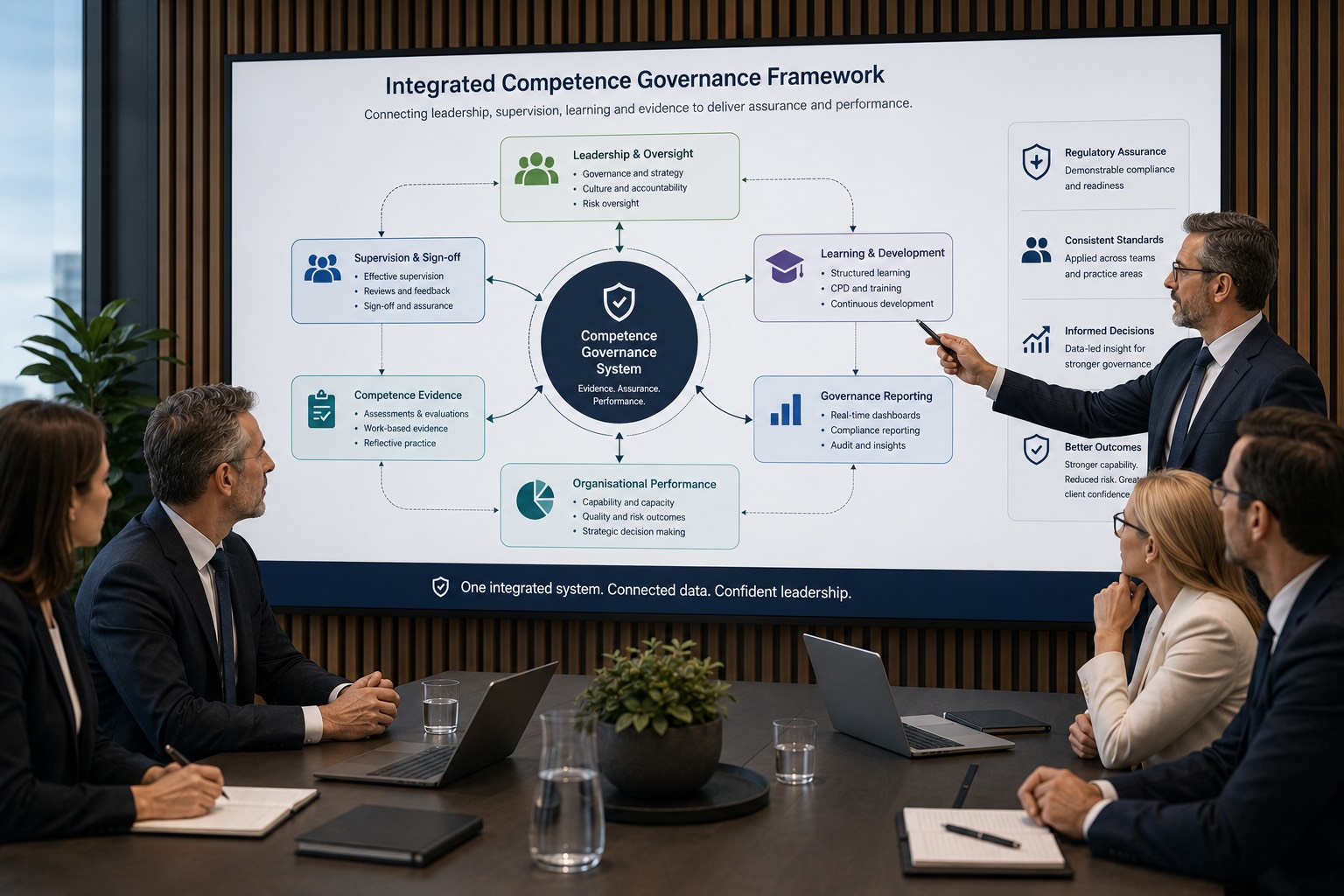
An effective competence governance system enables leadership to demonstrate:
- clearly defined competence expectations;
- structured supervision;
- meaningful professional development;
- reflective practice;
- evidence-based decision-making;
- governance reporting;
- continual improvement.
Together these elements provide a coherent picture of organisational capability.
The Importance of Evidence
Evidence transforms confidence into assurance.
Useful evidence may include:
- supervision records;
- development plans;
- reflective practice;
- file reviews;
- quality assurance findings;
- client feedback;
- competence dashboards;
- governance reports;
- annual declarations.
Importantly, no single document demonstrates competence.
Collectively, however, these sources provide a robust and balanced evidence base.
Common Organisational Challenges
Many firms encounter similar challenges when preparing for scrutiny.
These include:
Fragmented Information
Evidence exists but remains dispersed across multiple systems.
Inconsistent Supervision
Different departments apply different supervisory standards.
Limited Organisational Visibility
Leadership understands individual performance but lacks insight into organisational capability.
Retrospective Evidence Gathering
Information is assembled shortly before review rather than maintained continuously.
Competence governance addresses each of these challenges through structured organisational oversight.
Questions Every Firm Should Be Able to Answer
Preparing for scrutiny becomes significantly easier when organisations can answer a series of straightforward questions.
For example:
- What competence standards have we established?
- How do we support continuing competence?
- How is supervision managed?
- How are learning needs identified?
- How is competence evidenced?
- How are capability risks reviewed?
- How does leadership receive assurance?
- How do we improve our governance arrangements?
These questions encourage continual organisational reflection rather than last-minute preparation.
Regulatory Readiness Through Governance
Perhaps the greatest misconception surrounding regulatory preparation is that it begins when regulators become involved.
In reality, preparedness develops gradually through everyday governance.
Each supervision conversation.
Each development review.
Each reflective discussion.
Each competence dashboard.
Each governance meeting.
Together they create an organisation capable of demonstrating professional competence with confidence whenever required.
Creating Organisational Confidence
One of the most valuable outcomes of competence governance is confidence.
Professionals understand expectations.
Supervisors support development consistently.
Leadership receives reliable management information.
Evidence is readily available.
Rather than fearing scrutiny, organisations recognise it as an opportunity to demonstrate the strength of their governance arrangements.
This confidence benefits regulators, clients and the organisation itself.
Looking Ahead
The legal profession continues moving towards greater organisational accountability for professional competence.
Future regulatory expectations are likely to place increasing emphasis upon governance systems capable of demonstrating continual competence rather than isolated compliance activities.
Firms investing in competence governance today will therefore be well positioned to respond confidently to future scrutiny while simultaneously strengthening organisational capability and client service.
Ultimately, regulatory readiness becomes an outcome of good governance rather than a separate organisational objective.
Key Takeaways
- Regulatory scrutiny should be anticipated through continuous competence governance rather than last-minute preparation.
- Organisational assurance depends upon evidence gathered throughout the year.
- Leadership should understand and explain how competence is governed across the firm.
- Competence governance strengthens regulatory confidence while improving organisational capability.
- Well-governed organisations prepare for scrutiny every day through supervision, learning, evidence and continual improvement.
Conclusion
Preparing for regulatory scrutiny is not about producing more documents.
It is about creating organisations capable of demonstrating how professional competence is actively supported, evidenced and continually strengthened.
Competence governance provides the structure that makes this possible.
By integrating supervision, learning, evidence, leadership and organisational oversight, firms develop confidence that extends far beyond regulatory compliance.
When scrutiny occurs, they are not attempting to prove competence retrospectively.
They are simply demonstrating the governance systems they use every day to maintain professional excellence.
Ultimately, the organisations best prepared for regulatory scrutiny are those that have made competence governance part of the way they lead, support and continually improve their people.
CONTINUE READING
Read Other Articles in This Series
Previous Article

Governance Lessons from Other Regulated Professions
Next Article

How to record QWE effectively (and why it matters)
Explore Related Topics

Competence Records: What Good Looks Like
Recommended Next Step
Designing a Competence Governance System
